50 Loose Parts Play Ideas That Inspire Imagination and Independent Play

A basket of bottle caps can become a bakery, a rocket control panel, a mandala, or treasure for a pirate map. That is the magic of loose parts play. The materials do not tell children what to do. They invite children to decide.
Loose parts are open-ended objects that children can move, combine, sort, stack, carry, line up, pretend with, and transform. They might be natural items like pebbles and leaves, household items like cardboard tubes and lids, or craft scraps like ribbon and fabric. The best part is that loose parts encourage independent play. Children do not need an adult to explain the “right” way to use them. With a few safe materials and a little space, they can create their own worlds.
Start with a simple loose parts setup
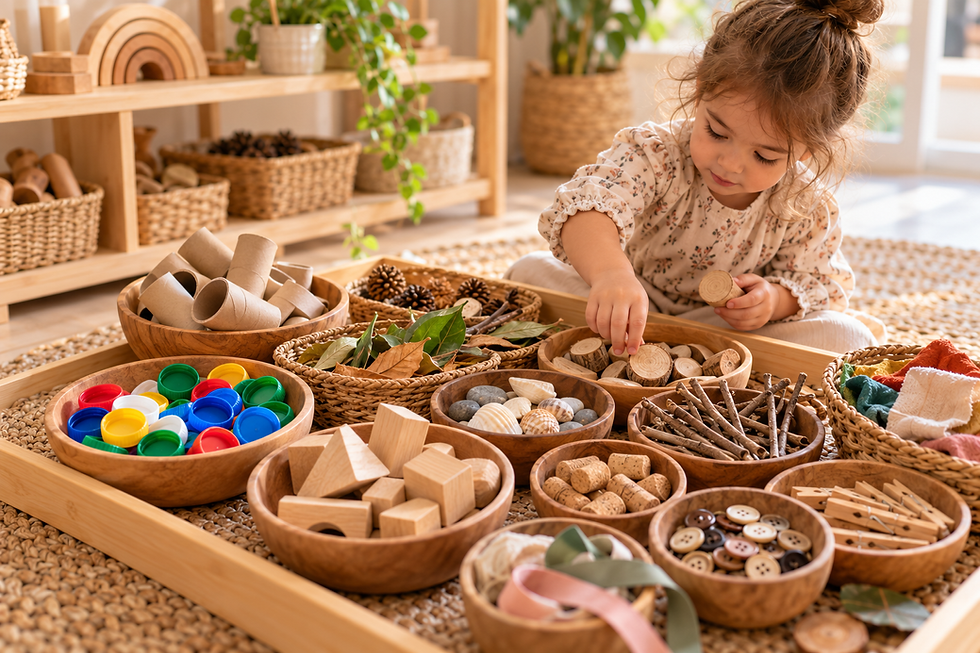
Loose parts work best when children can see what is available. Use shallow trays, baskets, bowls, or a low shelf. Offer a few materials at a time rather than everything at once.
Good starter materials include:
Wooden blocks
Pebbles and shells
Fabric scraps
Bottle caps
Cardboard tubes
Buttons for older children
Ribbon pieces
Corks
Pegs
Leaves, sticks, and seed pods
Keep safety in mind. Avoid small parts for children who still mouth objects. Check natural materials for sharp edges, insects, or mould. Supervise water play, mirror play, and anything that involves string, glass, or magnets.
Nature-based loose parts play ideas

Natural materials bring texture, colour, weight, and scent into play. They are easy to collect during walks, in a garden, or from a balcony plant corner.
Build a leaf village
Use leaves as roofs, stones as houses, and twigs as roads. Add small figures if your child likes story play.
Make a pebble pattern path
Invite children to line up pebbles in curves, spirals, zigzags, or long roads across the floor.
Create stick people and animals
Combine sticks, leaves, seed pods, and flowers to make characters. A short twig can become a tail, arm, or antenna.
Sort nature treasures by texture
Place smooth stones, rough bark, soft petals, and crunchy dry leaves into separate bowls.
Design a nature mandala
Start with one stone in the centre. Add circles of leaves, petals, shells, and twigs around it.
Open a pretend forest café
Stones become idlis, leaves become plates, and seed pods become snacks. Add bowls and spoons for richer pretend play.
Make mini habitats
Build homes for toy animals using moss, bark, leaves, and rocks. Talk about where each animal might rest or hide.
Create a stick maze
Lay sticks on the ground to form paths. Move a marble, seed pod, or toy animal through the maze.
Paint with leaves and flowers
Use washable paint and natural items as stamps. Children can press, swipe, dab, and layer colours.
10. Make a sensory nature tray
Fill a tray with sand, pebbles, dry leaves, and shells. Add scoops, cups, and small containers.
Household loose parts play ideas

Everyday objects often become the most loved play materials. They feel familiar but can be used in surprising ways.
11. Build with cardboard tubes
Stack, roll, balance, and connect tubes. Cut some into shorter pieces for tunnels and towers.
12. Make a lid matching game
Collect clean container lids in different sizes. Children can sort by colour, match them to containers, or build flat designs.
13. Create a button shop
Older children can sort buttons into tiny bowls, count them, pretend to sell them, or use them as coins.
14. Use pegs for fine motor play
Clip pegs onto bowls, cardboard, fabric, or string. This strengthens little fingers without worksheet practice.
15. Build a bottle cap mosaic
Arrange caps into flowers, faces, robots, letters, or abstract designs.
16. Make a cardboard city
Use boxes, tubes, lids, tape, and fabric scraps to create buildings, bridges, parks, and bus stops.
17. Open a sock puppet basket
Add old clean socks, buttons for older children, ribbons, fabric scraps, and paper pieces. Children can make characters without needing a fixed craft sample.
18. Create a kitchen band
Use spoons, steel plates, small containers, and wooden spatulas. Explore loud, soft, fast, and slow sounds.
19. Make roads with masking tape and lids
Tape roads on the floor and use lids, caps, or corks as cars. Add blocks for buildings.
20. Invent a treasure sorting station
Mix keys, corks, ribbons, lids, and safe bangles in a basket. Add bowls so children can sort and rearrange.
Building and engineering ideas

Loose parts are perfect for early STEM play because children test balance, force, size, shape, and stability through real action.
21. Build the tallest tower
Offer blocks, cardboard tubes, lids, and small boxes. Let children test which base works best.
22. Make bridges between books
Place two sturdy books apart and use cardboard, sticks, or blocks to create bridges.
23. Create marble runs
Use tubes, tape, boxes, and trays. Adjust the slope and watch how the marble changes speed.
24. Balance stones and blocks
Stack flat stones, wooden pieces, and corks. Try wide bases, narrow bases, and mixed shapes.
25. Design a parking garage
Use boxes, tubes, lids, and blocks. Toy cars can move through ramps, levels, and gates.
26. Build a tunnel system
Use tubes, boxes, scarves, and blocks for tunnels. Add small animals, cars, or balls
27. Make a ramp testing lab
Use a board, tray, or cardboard strip as a ramp. Roll corks, balls, lids, and toy wheels down it.
28. Construct a fence or enclosure
Use sticks, blocks, pegs, and stones to build a pen for toy animals.
29. Create a floating and sinking tray
Use a bowl of water with corks, leaves, stones, shells, and lids. Keep towels nearby.
30. Invent loose parts machines
Combine tubes, buttons, lids, strings, and boxes to make pretend washing machines, ticket counters, or rocket launchers.
Pretend play with loose parts

Loose parts stretch pretend play because one object can stand for many things. A stone can be a potato, a phone, a pet, or a magic crystal.
31. Set up a loose parts kitchen
Use shells, stones, leaves, bottle caps, bowls, and spoons. Children can cook, serve, and clean up.
32. Make a doctor’s clinic
Fabric scraps become bandages, corks become medicine bottles, and cardboard pieces become appointment cards.
33. Create a travel station
Use bottle caps as coins, cardboard as tickets, and blocks as luggage. Toy people can take buses, trains, or flights.
34. Open a flower shop
Use real or fabric flowers, ribbons, pebbles, and paper wraps. Children can make bouquets and arrange displays.
35. Build a small world farm
Use green fabric for fields, stones for boundaries, sticks for fences, and toy animals.
36. Make a space mission
Cardboard tubes become rockets, foil becomes moon rocks, and lids become control buttons.
37. Create a puppet theatre
Use a box, fabric, sticks, and loose characters made from paper or socks.
38. Open a loose parts post office
Use envelopes, cardboard stamps, bottle cap seals, and blocks as parcel counters.
39. Make a festival scene
Use flower petals, fabric, beads for older children, and paper pieces to create decorations, rangoli, stalls, or lights.
40. Create a rescue centre
Use blocks, fabric, toy animals, tubes, and boxes. Children can build shelters and care spaces.
Art, pattern, and early maths ideas

Loose parts make early maths visible. Children sort, compare, count, order, measure, and pattern while playing.
41. Make repeating patterns
Try stone, leaf, stone, leaf. Then add a third item like a shell or stick.
42. Create loose parts letters
Form letters using buttons, pebbles, sticks, bottle caps, or ribbon.
43. Count with treasure bowls
Place number cards near bowls. Children add the matching number of shells, caps, or stones.
44. Make faces with loose parts
Use lids for eyes, yarn for hair, pebbles for noses, and fabric for mouths.
45. Design rangoli-inspired patterns
Use petals, coloured lids, buttons for older children, and dry grains under supervision.
46. Compare long and short lines
Make lines using sticks, ribbons, or blocks. Ask which is longer, shorter, curved, or straight.
47. Trace shadows with loose parts
Place objects in sunlight and outline their shadows with pebbles or buttons.
48. Make a loose parts colour hunt
Pick one colour and gather matching items from a prepared basket.
49. Create story stones
Draw simple pictures on smooth stones, such as a tree, house, sun, or fish. Children can pick stones and tell a story.
50. Build a memory tray
Place five to eight loose parts on a tray. Let the child look, cover it, remove one item, and guess what changed.
How to keep loose parts play independent

The adult role is simple: prepare, observe, and step back. Too many prompts can turn open-ended play into a task.
Try these gentle supports:
Put materials where children can reach them.
Use trays so setup and clean-up feel manageable.
Rotate items every few days.
Keep one “always available” basket for favourite parts.
Offer a play mat to define the space.
Take photos of creations before tidying.
Ask open questions only when needed.
Helpful questions include:
“What are you making?”
“What could this become?”
“What do you need next?”
“How did you make it balance?”
If a child dumps everything out, that can be part of the exploration. If the play becomes chaotic, reduce the number of items rather than ending the activity. Fewer pieces often lead to deeper play.
Choose simple materials and let the ideas grow
Loose parts do not need to be expensive, perfect, or Pinterest-ready. A bowl of shells, a handful of lids, some cardboard tubes, and a few fabric scraps can keep children busy for a long time.
Start with five to ten safe materials. Watch what your child does with them. Then add one new texture, shape, or challenge. The richest play often begins when adults stop directing and children start deciding.


Comments