Beautiful Invitations to Play at Home with Playdough, Loose Parts and Sensory Play
A child can walk past a basket of toys all morning, then spend 40 minutes arranging bottle caps in a lump of playdough because it was set out in just the right way.
That is the quiet magic of an invitation to play. It does not need a new toy, a perfect theme, or a shelf that looks like a preschool catalogue. It needs a few thoughtful materials, a clear space, and enough openness for a child to decide what happens next.
Playdough, loose parts, and sensory play work beautifully together because they offer texture, choice, movement, and imagination. At home, they can become roads, laddoos, gardens, birthday cakes, nests, shops, rangolis, faces, monsters, or anything else a child sees in them.

What makes an invitation to play work
An invitation to play is a prepared setup that gently suggests an activity without deciding the result. It might be a ball of green playdough beside leaves and twigs. It might be a tray of coloured rice with cups and spoons. It might be dough, buttons, and candles laid out like a pretend bakery.
The key word is invitation. It should feel welcoming, not instructional.
A good setup usually has four parts.
A base material Playdough, clay, sand, water, rice, dal, fabric scraps, or paper.
Loose parts Objects that can be moved, sorted, stacked, pressed, counted, hidden, or transformed.
Simple tools Rolling pins, spoons, cups, child-safe scissors, cookie cutters, tongs, or small bowls.
Enough space A tray, mat, table, thali, or floor area where the child can explore without constant correction.
The difference between a craft and an invitation to play is the end goal. A craft often says, “Make this.” An invitation says, “What could this become?” That small shift matters. The child can follow an idea, change it, abandon it, and return to it. The adult can step back and observe rather than manage every step.
Start with playdough as the anchor
Playdough is one of the easiest materials to use at home because it holds a shape, changes quickly, and suits many ages with supervision. It is calming for some children, energising for others, and useful on days when everyone needs a low-pressure activity.
You do not need ten colours. One or two are enough. In fact, fewer colours often lead to deeper play because the child focuses on shape, texture, and story.
A basic playdough setup could include:
One ball of dough
A small rolling pin or clean bottle
A few cookie cutters
Three small bowls of loose parts
A tray or mat
Choose loose parts that match the mood of the setup. For a garden, offer leaves, flowers, twigs, and pebbles. For a pretend sweet shop, offer cupcake cases, beads, buttons, and small paper squares. For construction play, offer ice-cream sticks, corks, blocks, and bottle caps.
Keep the dough soft and easy to press. If homemade dough dries out, knead in a few drops of oil or water. Store it in an airtight box. If it smells sour, feels sticky in an unpleasant way, or shows any mould, throw it away. For younger children, avoid very salty dough if they are likely to taste it often. Always supervise, especially with small loose parts.

Choose loose parts with care and curiosity
Loose parts are open-ended materials that children can use in many ways. A peg can become a candle, a person, a tree trunk, or a shop item. A shell can become a plate, a roof, a boat, or a dinosaur scale.
At home, loose parts are everywhere.
The best ones are often ordinary.
Try collecting from these categories.
Nature finds
Leaves, seed pods, flowers, sticks, shells, stones, feathers, and dry coconut shells can add texture and beauty. Wash and dry items when needed. Avoid sharp, dirty, or unknown plant materials.
Kitchen materials
Dry pasta, rajma, chana, cinnamon sticks, star anise, cups, spoons, steel katoris, strainers, and small trays can support scooping, sorting, pretend cooking, and pattern making. Use food items thoughtfully and avoid waste where possible. Store dry materials for repeated play.
Recycled materials
Bottle caps, cardboard tubes, fabric scraps, ribbon pieces, lids, corks, small boxes, and clean packaging can become construction parts or storytelling props.
Craft supplies
Pom-poms, buttons, pipe cleaners, craft sticks, wooden beads, cupcake liners, stamps, and sequins can work well with playdough. Pick larger pieces for younger children.
The most important safety rule is simple: if an item can fit fully inside a young child’s mouth, treat it as a choking risk. Supervise closely, or save those materials for older children who no longer mouth objects.
Loose parts do not need to be colourful or expensive. A small basket with ten smooth stones can invite counting, stacking, mandala making, pretend cooking, and storytelling. Fewer materials often produce better play because children are not overwhelmed.

Add sensory play without making the whole house messy
Sensory play has a reputation for chaos, but it can be contained. The trick is to decide the boundary before you begin.
Use a tray, shallow tub, old bedsheet, silicone mat, thali, or large cardboard box. Keep a small cloth nearby for spills. If water is involved, place the setup in the balcony, bathroom, courtyard, or near an easy-to-clean floor.
Sensory play does not only mean slime or giant bins of rice. It can be small and manageable.
Try these simple bases:
Rava or rice for scooping and pouring
Water with lemon slices and spoons
Ice cubes in a bowl with droppers
Coloured water in steel cups
Dry leaves for crunching and sorting
Fabric scraps for soft, rough, smooth, and silky textures
Cooked spaghetti for older children who enjoy squishy textures
Sand or mud in an outdoor space
When combining sensory play with playdough, use contrast. Soft dough with crunchy leaves. Smooth stones with grainy rava. Cool ice beside warm-coloured dough. Scented spices near plain dough. This helps children notice differences. They squeeze, smell, tap, pour, press, sort, and compare. That is rich learning, even when it looks like simple play.
If mess is a concern, start with dry sensory play. Rice, dal, pasta, and fabric are easier to contain than water or mud. Begin with small quantities. A cup of rice is enough for a toddler-sized tray.

Build beautiful setups without over-styling them
A beautiful invitation to play is not about making a display that children are afraid to touch. Beauty can come from order, balance, and materials that feel pleasant to use. Think of the setup as a beginning, not a finished picture.
Use a tray to frame the materials. Place the playdough in the centre or to one side. Put loose parts in small bowls, muffin tins, coconut shells, or steel katoris. Leave some empty space so the child has room to create.
Colour can help the setup feel calm. You might choose:
Green dough with leaves, pebbles, and twigs
Yellow dough with flowers, turmeric-coloured rice, and wooden beads
White dough with shells, buttons, and silver paper
Brown dough with cinnamon sticks, seed pods, and corks
Pink dough with fabric scraps, paper hearts, and buttons
You can also choose a familiar home theme.
A few lovely ideas:
A pretend chai stall
Set out brown playdough, small cups, spoons, cardamom pods, cinnamon sticks, and bottle caps. Children can make biscuits, cups, coins, menus, or snacks.
A mini garden
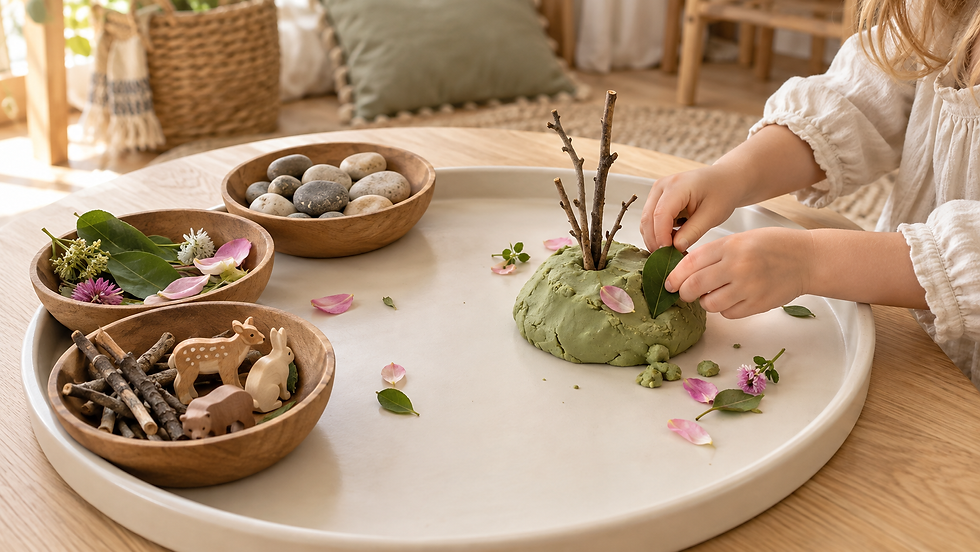
Use green or brown dough with leaves, petals, stones, sticks, and toy animals. The child might plant trees, make ponds, build homes, or create insects.
A festival tray
Offer dough with flower petals, diyas without flames, beads, and coloured rice. Invite pattern making, rangoli designs, sweet boxes, or pretend celebration play.
A bakery counter
Set out dough, cupcake liners, buttons, candles, beads, and a rolling pin. Children can make cakes, ladoos, cookies, or an entire shop.
A face-making station
Offer dough with buttons, yarn, leaves, bottle caps, shells, and craft sticks. Children can make people, animals, monsters, or family portraits.
Try not to correct the result. If a child says a lump with three sticks is a tiger, it is a tiger. The point is meaning, not realism.
Know when to join and when to step back
The adult role in this kind of play is subtle. Too much direction can turn open play into a task. Too little presence can make a child lose interest, especially at the start.
Begin by sitting nearby. Touch the materials slowly. Roll a small ball. Press a shell into the dough. Then pause. Let the child take the lead.
Use comments more than questions.
Instead of asking, “What are you making?” every few minutes, try:
“You pressed that stone very deep.”
“This part is getting taller.”
“You chose all the round pieces.”
“That dough changed shape when you rolled it.”
“I see a long line of leaves.”
These comments show attention without testing the child.
If the play gets stuck, add one small idea. Place a leaf upright in the dough. Put two bottle caps side by side. Offer a spoon. Then step back again.
The best invitations often continue in unexpected directions. A bakery becomes a birthday party. A garden becomes a jungle. A sensory tray becomes a road. Follow the child’s story when invited, but do not rush to lead it.
Keep a simple rotation so it stays fresh
You do not need a new setup every day. Repetition helps children go deeper. Keep the same base and change only one part.
For example:
Day | Keep the same | Change one thing |
Monday | Green playdough | Add leaves and sticks |
Tuesday | Green playdough | Add stones and toy insects |
Wednesday | Green playdough | Add flowers and small bowls |
Thursday | Green playdough | Add rice and spoons |
Friday | Green playdough | Add craft sticks and bottle caps |
This saves effort and reduces clutter. It also helps children discover new uses for familiar materials.
Store loose parts by type in small boxes, cloth pouches, or reused containers. Keep only a few categories accessible at a time. Too much choice can make play scattered.
A good home collection might include:
One box of natural materials
One box of recycled parts
One box of craft items
One basket of tools
One tray or mat for setups
When a setup has finished, involve the child in sorting and packing away if they are old enough. Cleanup becomes part of the rhythm rather than a separate battle.

Make it safe, calm and child-led
Beautiful play should still be practical. Before setting anything out, do a quick safety check.
Ask yourself:
Can any piece become a choking hazard?
Is the material clean and non-toxic?
Are there sharp edges, splinters, or broken bits?
Will this stain the floor, clothes, or table?
Is the child likely to throw, eat, or pour it?
Can the mess be cleaned without stress?
For toddlers, use large loose parts such as big wooden rings, large fabric squares, chunky blocks, jumbo buttons, and kitchen tools. For older children, smaller beads, shells, and craft pieces can add detail. Also watch for sensory comfort. Some children love sticky, rough, or wet textures. Others avoid them. Offer tools so the child can join without touching everything directly. Tongs, spoons, brushes, and cups make sensory play more accessible. The goal is not to make every child love every texture. The goal is to give safe chances to explore at their own pace.

A simple invitation to try today
If you want a low-effort setup, start here.
Place a tray on the floor or table. Add one ball of playdough, a small bowl of pebbles, a few leaves, two sticks, and a spoon. Say, “I made this for play,” and then wait. That is enough.
If the child wants a prompt, offer one gentle idea: “I wonder if this could become a garden.” Then let the idea change. It might become soup, a mountain, a dinosaur nest, or a birthday cake. All of those are successful outcomes.
The beauty of playdough, loose parts, and sensory play is that they meet children where they are. They support fine motor strength, language, problem solving, pretend play, focus, and creativity without turning the moment into a lesson.
A beautiful invitation to play at home does not need to be elaborate. It needs care, safety, and room for the child’s ideas. Start small, repeat often, and let the materials do their quiet work.


Comments