How Invitations to Play Support Early Childhood Development and School Readiness
A child does not need a worksheet to practise focus, counting, language, problem-solving, or self-control. Often, a tray of bottle caps, a few bowls of coloured water, some leaves, and a question like “What can you make?” can do far more.
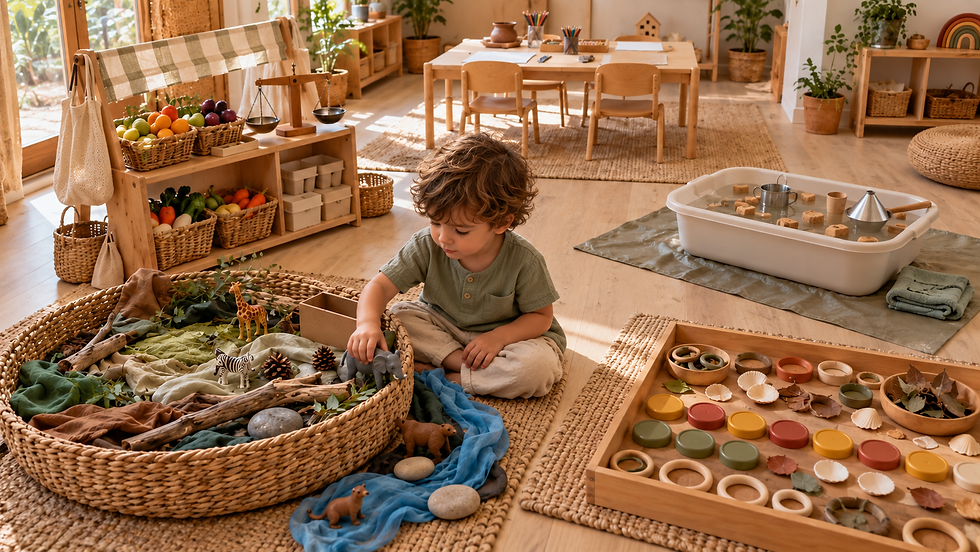
That is the strength of an invitation to play. It is a thoughtfully arranged play setup that invites a child to explore, imagine, test ideas, and make choices. The adult prepares the environment, then steps back enough for the child to lead.
For early childhood, this matters deeply. Young children learn through movement, touch, talk, repetition, and pretend play. They build school readiness not only by recognising letters and numbers, but by learning how to listen, persist, share space, follow routines, express ideas, and try again after something fails.
What an invitation to play really means
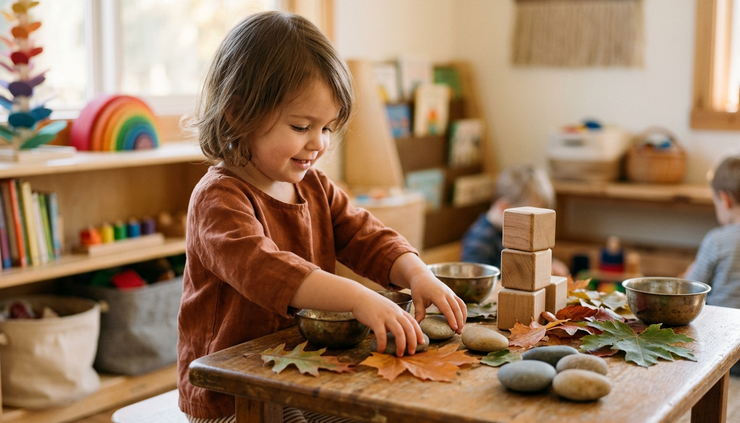
An invitation to play is not the same as a craft activity with one expected result. It is also not a pile of toys dropped on the floor. It sits somewhere in between.
The adult chooses materials with care and arranges them in a way that sparks curiosity. The child decides what to do with them.
A simple setup might include:
Shells, stones, leaves, and small baskets
Dough, sticks, and buttons
Toy animals, blocks, and fabric pieces
Measuring cups, water, funnels, and spoons
Paper, crayons, glue, and natural materials
There may be a loose prompt, but not a fixed answer. For example, instead of saying, “Make a house exactly like this,” the adult might ask, “Who could live here?” or “How can we make the bridge stronger?”
That small shift changes the learning. The child is not just following directions. They are planning, testing, changing, explaining, negotiating, and creating meaning.
Why play builds real school readiness
School readiness is often misunderstood. It is easy to reduce it to alphabet drills, number writing, or sitting still for long periods. Those skills have a place, but they are not the whole picture.
A child who is ready for school needs a broader set of abilities:
To separate from a caregiver with growing confidence
To understand and follow simple routines
To communicate needs and ideas
To handle frustration with support
To listen, take turns, and join group activity
To use fingers, hands, and body with control
To notice patterns, amounts, shapes, sounds, and stories
To stay with a task long enough to learn from it
Invitations to play support these areas because they combine freedom with gentle structure. The child is not left without support, and they are not controlled at every step. This balance suits early childhood development because young children learn best when they feel safe, interested, and involved.
Play is not a break from learning in the early years. It is one of the main ways learning happens.
How invitations to play support key areas of development
They build language through real conversation
Children use richer language when they have something meaningful to talk about. A child making a pretend tea stall may use words like cup, pour, hot, customer, money, more, finished, and wait. A child building a road may talk about long, short, stuck, fast, slow, bridge, and tunnel.
Adults can extend this without turning play into a lesson. The trick is to describe, wonder, and respond.
Useful adult phrases include:
“I can see you made the tower taller.”
“What do you think will happen if we add one more block?”
“Tell me about this part.”
“You used the big spoon for pouring.”
“The water is moving quickly through the funnel.”
This kind of talk builds vocabulary, sentence structure, listening skills, and confidence. It also helps children connect words to actions, objects, and feelings.
They strengthen executive function
Executive function is the set of mental skills that helps children plan, remember instructions, control impulses, and shift behaviour when needed. These skills are closely linked to classroom life.
A child using an invitation to play practises executive function in natural ways. They choose a plan, hold it in mind, adjust when it does not work, and manage excitement or disappointment.
For example, while making a ramp for toy cars, a child may realise the car keeps falling off. They try a wider plank, add blocks at the sides, or change the height. That is problem-solving, flexible thinking, and persistence in action.
The learning feels like play, but the mental work is serious.
They support fine and gross motor development
Before children write comfortably, they need strength and control in their fingers, wrists, arms, shoulders, and core. Invitations to play can build these foundations without pressure.
Fine motor play may include:
Pinching dough
Threading beads
Picking up seeds with fingers or tongs
Tearing paper
Pouring water
Drawing lines and shapes
Sticking collage pieces
Gross motor play can be invited too. A path made of cushions, a basket of scarves, or chalk lines on the floor can invite children to jump, balance, crawl, stretch, and coordinate movement.
These actions prepare the body for school tasks such as holding a pencil, opening a lunch box, turning pages, using scissors, sitting upright, and moving safely in a group.
They nurture social and emotional growth
Invitations to play often lead to shared play. When two or more children use the same materials, they practise skills that matter in every classroom.
They learn to say:
“Can I have a turn?”
“Let’s make it together.”
“I need that block.”
“You can use this one.”
“I don’t like that.”
“Let’s start again.”
There will be disagreements. That is part of the learning. An adult can help by naming feelings and guiding repair, rather than solving every problem immediately.
For example:
“Both of you want the red bowl. One child can use it now, and one can use it after the timer. What can we use while we wait?”
This helps children learn fairness, patience, language for conflict, and emotional control. These skills are central to school readiness because school is a social place.
They build early maths and science thinking
Young children meet maths and science through hands-on exploration long before formal lessons begin.
When they sort shells, compare sticks, pour water, stack blocks, or make patterns, they explore concepts such as:
More and less
Heavy and light
Full and empty
Tall and short
Same and different
Number and quantity
Balance and force
Sink and float
Cause and effect
A water play invitation with cups and funnels can become a lesson in volume and flow. A block play setup can become an introduction to height, balance, symmetry, and stability. A nature tray can lead to observation, classification, and early scientific language.
The adult does not need to explain everything. Often, the best support is a thoughtful question.
“What do you notice?”
“Why do you think this one rolled faster?”
“How can we find out?”
What makes an invitation to play effective
A good invitation to play does not need expensive toys. In many Indian homes and early learning spaces, everyday materials work beautifully: steel bowls, dupattas, coconut shells, cardboard boxes, rangoli colours, bangles, seed pods, clay, old calendars, cloth scraps, and kitchen spoons.
What matters is the intention behind the setup.
Keep it open-ended
Open-ended materials can be used in many ways. A block can become a phone, a bridge, a bus, or a piece of cake. A scarf can become a river, a blanket, a sari, a road, or a tent.
This flexibility supports imagination and problem-solving. It also allows children at different developmental stages to use the same materials in different ways.
A three-year-old may line up animal figures. A five-year-old may build a forest and create a story. Both are learning.
Offer just enough structure
Too much structure can limit thinking. Too little can overwhelm children. A clear arrangement helps children begin.
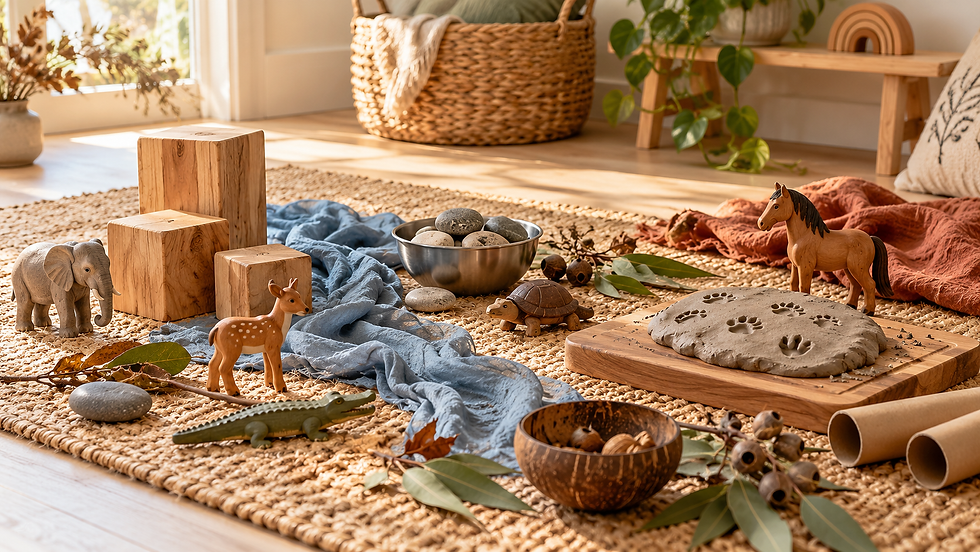
For example, instead of placing many mixed materials in a large box, try arranging a few items neatly on a mat:
A small bowl of stones
Three wooden blocks
A few toy animals
A piece of blue cloth
Some leaves
This says, “Come and explore.” It gives a starting point but leaves the direction open.
Match the setup to the child’s stage
The same idea can be adjusted for different ages.
For younger toddlers, use larger, safe materials and simple sensory exploration. For example, big fabric pieces, balls, nesting cups, and chunky blocks. For older preschoolers, add materials that invite planning, storytelling, counting, drawing, measuring, and collaboration.
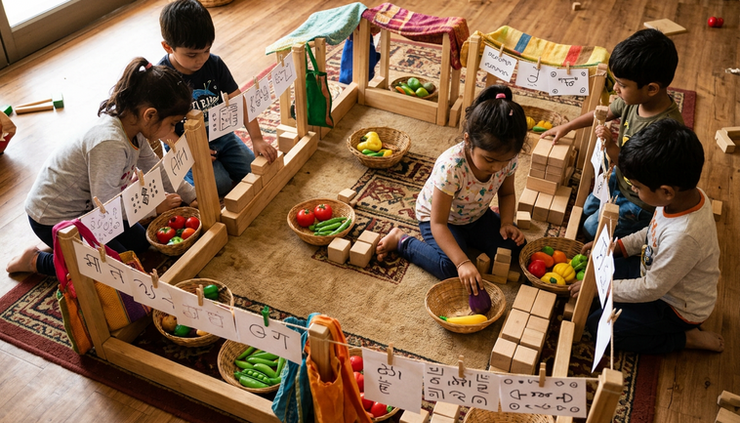
A building invitation for younger children might include soft blocks and toy animals. For older children, it might include cardboard tubes, tape, pebbles, rulers, paper signs, and a challenge to make a zoo, bridge, or market.
Repeat materials in new ways
Children need repetition. They may return to the same material many times before they discover its full possibilities.Dough can become food one day, letters another day, animal tracks the next day, and a map later in the week. Repetition builds mastery. Small changes keep curiosity alive. This is why invitations to play do not have to be new every day. A familiar set of materials, arranged with a new question or added object, can feel fresh.
Practical invitation ideas for home and preschool
The best setups are simple enough to prepare and rich enough to sustain attention.
A storytelling basket
Place a few animal figures, fabric scraps, stones, sticks, and a small box in a basket. Invite the child to create a story. This supports oral language, sequencing, imagination, and emotional expression. After the play, the adult can say, “Tell me what happened first,” or “What happened to the tiger after it crossed the river?”
A mini market
Set out empty food packets, pretend money, small bags, weighing cups, labels, and baskets. Children can become sellers, buyers, or helpers. This builds social language, counting, sorting, turn-taking, and early understanding of daily life. In an Indian context, this can connect naturally to vegetable markets, kirana shops, flower stalls, or fruit carts.
A loose parts pattern tray
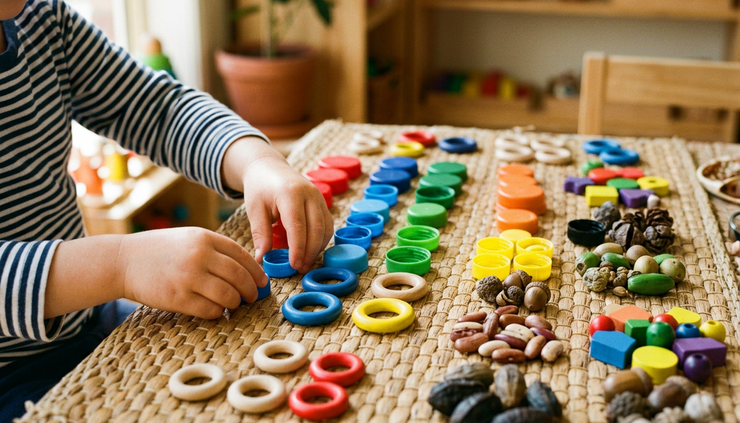
Offer buttons, bottle caps, leaves, seeds, shells, or bangles. Invite children to sort, arrange, count, and make patterns. This supports early maths, visual discrimination, fine motor skills, and concentration. Children may begin with simple grouping, then move towards repeating patterns like red-blue-red-blue.
A water investigation station
Use a tub, cups, spoons, funnels, small containers, and floating objects. Keep towels ready and set clear boundaries. Children explore pouring, filling, emptying, floating, sinking, and measuring. They also practise patience and control, especially when sharing tools.
A mark-making table
Place paper, crayons, chalk, old envelopes, labels, and clipboards near a pretend play setup. If children are playing shop, they can make bills or signs. If they are playing doctor, they can make patient cards. This gives writing a real purpose. Children see marks as communication, not only as handwriting practice.
The adult’s role is quiet but powerful
An invitation to play works best when adults observe before entering. Children often have a plan that is not obvious at first. If adults step in too quickly, they may interrupt the thinking.
A helpful rhythm is:
Watch what the child is doing.
Notice the skill or idea behind the action.
Join only when needed or invited.
Add language, a question, or one new material.
Step back again.
For example, if a child keeps stacking blocks and knocking them down, the adult may notice balance, height, force, and repetition. Instead of stopping the play, they might say, “You are testing how tall it can get before it falls.”
That sentence gives value to the child’s work. It also adds language to the experience.
Adults can also document learning through photos, notes, or saved work. A short note such as “Aarav used six blocks to make a bridge and changed the base when it fell” captures planning, counting, persistence, and problem-solving.
Common mistakes to avoid
Invitations to play are simple, but a few habits can weaken them.
Making the outcome too fixed
If every child must make the same butterfly, house, or flower, the activity becomes more about copying than thinking. There is nothing wrong with guided craft at times, but it serves a different purpose.
For open-ended play, allow different results.
Offering too many materials
A crowded setup can distract children. Start with fewer materials and add more if play becomes flat. Too many choices can make it hard to begin.
Asking too many questions
Questions can support thinking, but constant questioning can feel like a test. Balance questions with quiet observation and simple comments.
Instead of asking, “What colour is this? How many are there? What shape is that?” try saying, “You found all the round ones,” or “This line is getting longer.”
Cleaning up too quickly
Some play takes time to grow. A child may spend ten minutes arranging materials before the real story begins. If possible, allow children to return to a setup later.
When cleanup must happen, give warning and involve children in restoring the space. This builds responsibility and routine.
How to know the play is working
An invitation to play is working when children show engagement. This does not always look quiet. It may look active, talkative, messy, or full of movement.
Look for signs such as:
Children return to the materials more than once
They create their own rules or stories
They talk about what they are doing
They try different solutions
They invite others into the play
They manage small conflicts with support
They show pride in their ideas
They stay with the activity longer over time
Progress may be small. A child who once grabbed materials may begin to wait. A child who rarely spoke may start naming objects. A child who avoided group play may sit beside others, then slowly join in.
These changes matter. They show growing readiness for the routines, relationships, and learning demands of school.

A simple way to begin this week
Start with one small invitation. Choose a quiet corner, a mat, or a low table. Pick five to eight safe materials. Arrange them with care. Add one gentle prompt.
Try one of these:
“What can you build for these animals?”
“How can we make a pattern?”
“What story can these things tell?”
“Which objects can float?”
“How can we make a shop?”
Then watch. Let the child lead. Add language when it helps. Step back when the play is flowing.
The aim is not to create a perfect setup. The aim is to create a space where children feel curious, capable, and ready to try.
Invitations to play build early childhood development and school readiness because they respect how young children actually learn. They give children hands-on experiences, real choices, meaningful language, and room to practise the skills that school will ask of them later.
A few everyday materials, arranged with thought, can open the door to deep learning.

Comments