How to Create a Sensory Play Tray That Your Child Will Love
A good sensory play tray can turn ten quiet minutes into a rich little world of scooping, pouring, sorting, squishing, smelling, and pretending. The best part is that it does not need fancy toys. A tray, a few safe household materials, and one clear idea are enough.
Sensory play helps children explore texture, sound, weight, colour, and movement through their hands and senses. It can also support fine motor skills, early problem-solving, language, focus, and independent play. For many children, it is simply calming and fun.
The trick is to keep it simple. A crowded tray looks exciting to adults, but children often enjoy a tray more when it has fewer materials and a clear invitation to play.
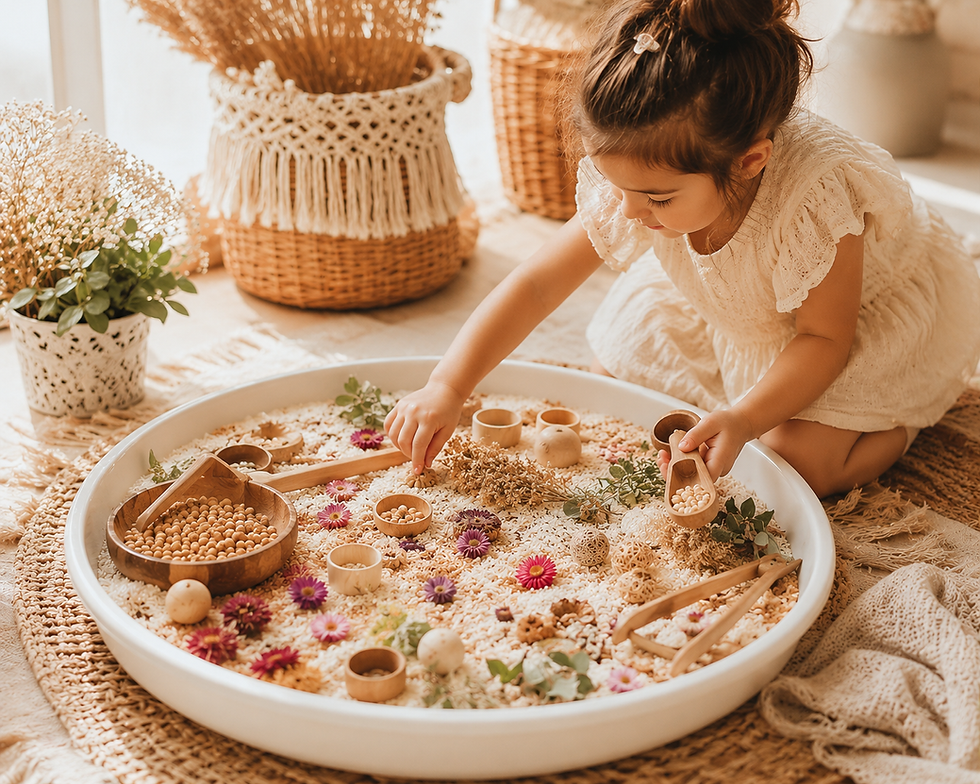
Start with a tray that gives play a clear boundary.
A sensory tray needs a contained space. This helps children understand where the play happens and makes cleanup much easier.
Good tray options include:
A shallow baking tray
A thali with raised edges
A plastic storage lid
A lunch tray with sections
A washing-up tub for water play
A wide basket lined with cloth
For toddlers, choose a tray with higher sides. For older preschoolers, a flatter tray works well because they can arrange, sort, and build more freely.
Place the tray on a washable mat, an old bedsheet, or even newspaper if the activity is dry. If your child is likely to toss or pour widely, set it up on the balcony, verandah, bathroom floor, or any easy-to-clean area.
The boundary matters because it reduces stress for both child and caregiver. Children can explore freely inside the tray, and adults do not have to correct them every few seconds.
Choose one main sensory base.
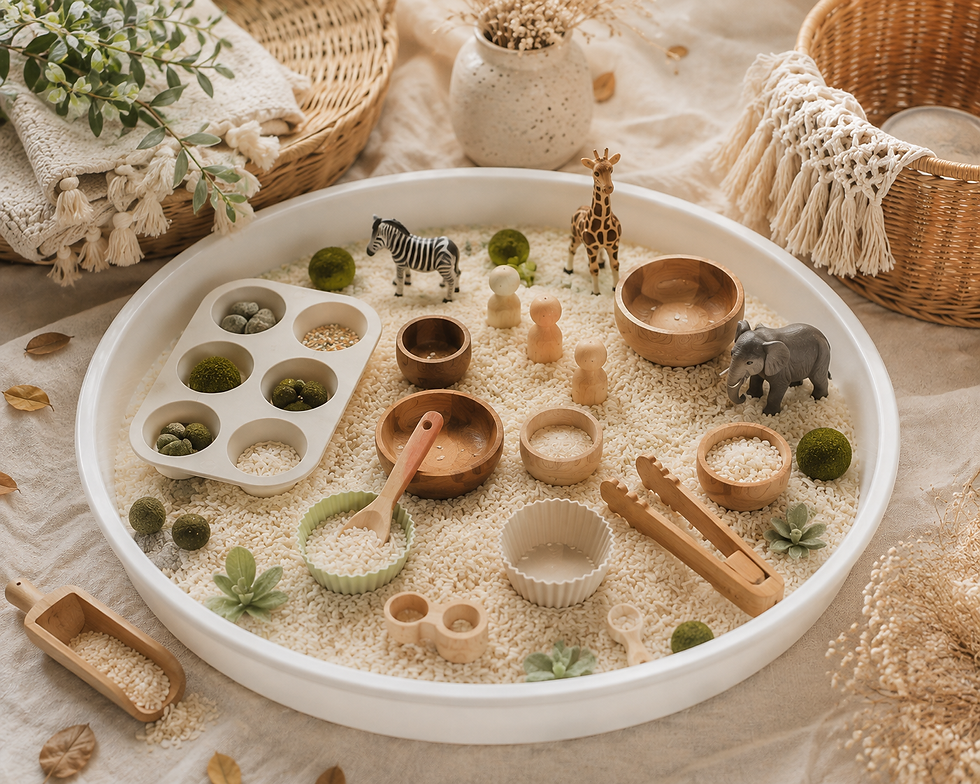
The base is the material your child will touch the most. Pick one main base per tray. Too many textures at once can feel messy or overwhelming.
For dry play, try:
Rice
Dal
Rajma or chana for older children
Rava
Oats
Torn paper
Cotton balls
Fabric scraps
Pom-poms
Leaves and flower petals
For wet or soft play, try:
Water
Ice cubes
Cooked pasta
Jelly
Cornflour and water
Atta dough
Soap foam
Mud, if outdoor play is possible
For babies and mouthing toddlers, use extra care. Avoid small items, uncooked beans, beads, buttons, and anything that could be a choking risk. Edible does not mean safe for unsupervised play. Always stay close. A simple rule helps: if it fits inside a small bottle cap, keep it away from children who still put things in their mouth.
Add tools that invite action.
Tools turn a tray from “something to touch” into “something to do.” Children love actions they can repeat. Scoop, pour, press, hide, find, pinch, stack, wash, squeeze, and stir.
Useful tools include:
Spoons
Small bowls
Ice cube trays
Measuring cups
Tongs
Funnels
Muffin trays
Toy animals
Cookie cutters
Small sieves
Droppers
Child-safe tweezers
Small ladles
You do not need all of them. In fact, three to five tools are usually enough.
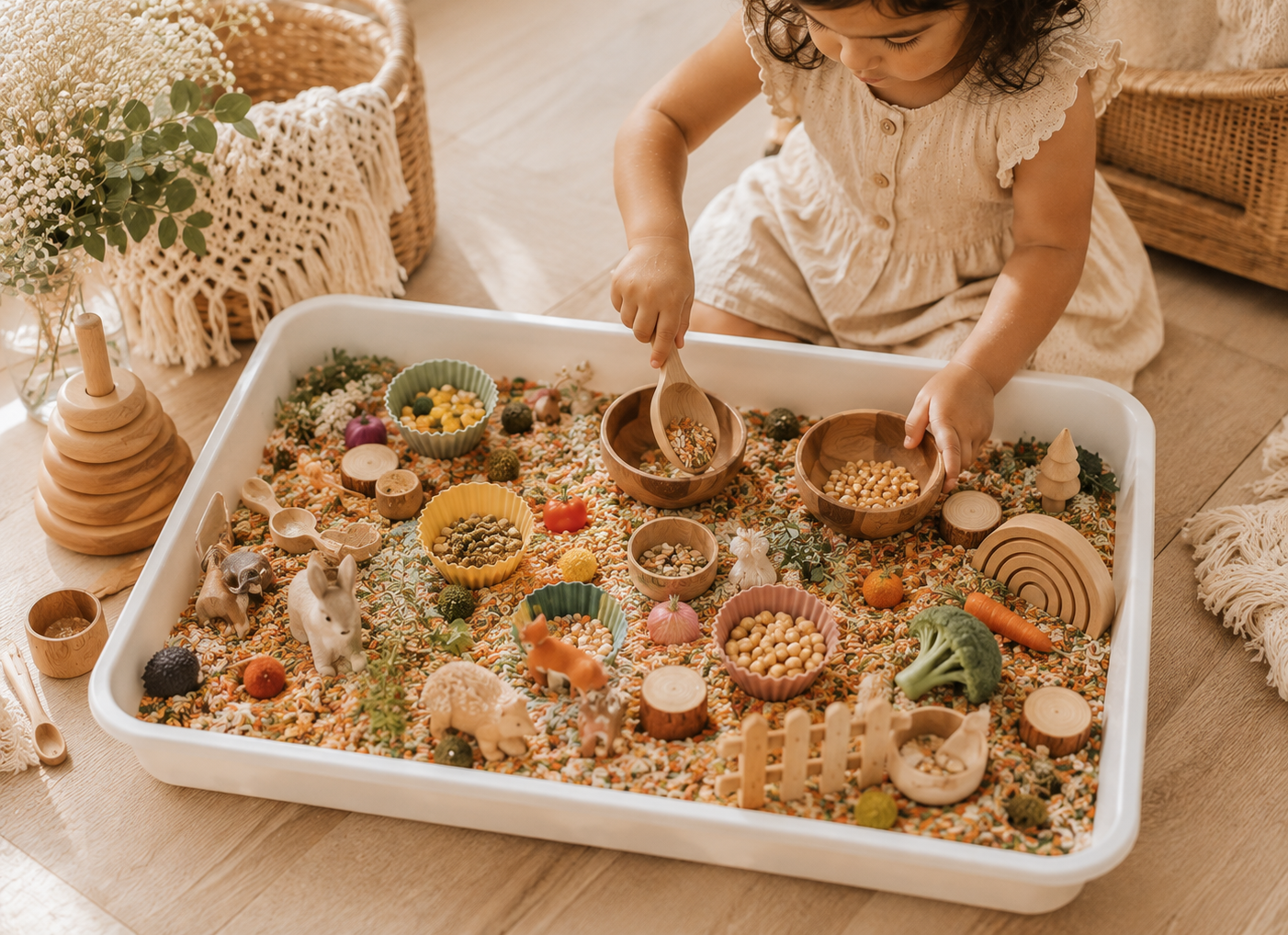
For a toddler, try rice, two bowls, and one spoon. For a four-year-old, add tongs, number cards, and small toy animals to create a rescue game. For an older child, add a challenge, such as sorting by colour, making patterns, or building a small pretend market.
Build the tray around a simple theme.
A theme gives the tray a story. It does not need to be elaborate. One small idea is enough to help a child enter the play. Try these easy themes.
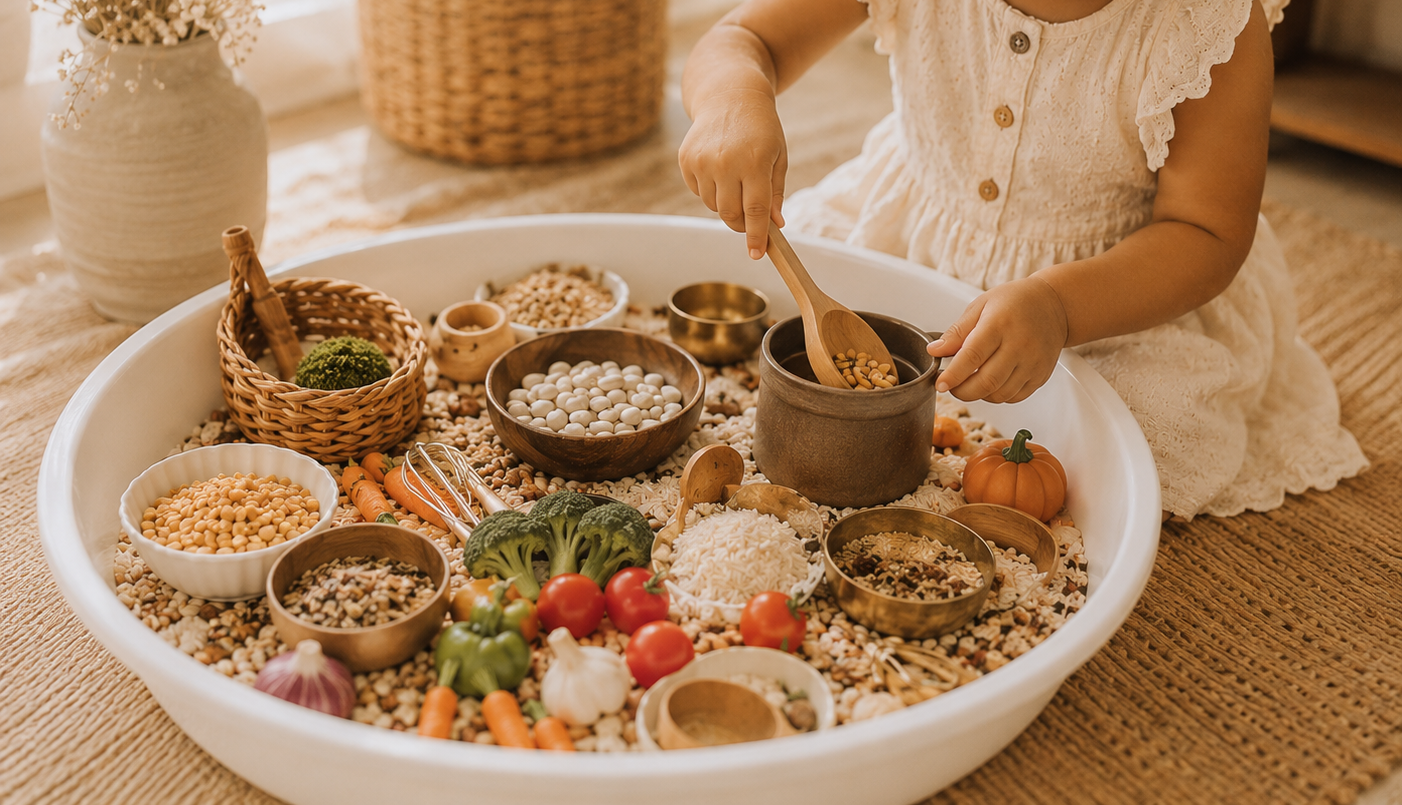
Make a pretend kitchen.
Use rice, dal, small bowls, spoons, and a few toy vegetables. Children can “cook,” mix, serve, and feed doll or soft toys. This works especially well for children who enjoy imitating daily life. It also builds language naturally. Words like more, less, full, empty, hot, cold, mix, and serve come up without a formal lesson.
Create a garden tray.
Use leaves, petals, soil or cocopeat, pebbles, and toy insects. Add a small spoon as a “garden tool.”
This is a lovely option for balcony play. Children can hide toy bugs under leaves, make paths with pebbles, or pretend to plant seeds.
Set up an ocean tray
Use blue-coloured water, toy fish, shells, smooth stones, and a small sieve. Keep towels nearby. If you do not want food colouring, use plain water and blue bowls or blue paper under a transparent tub. Children usually care more about pouring and rescuing than the exact colour.
Try a festival tray
Use flower petals, diyas without flames, rangoli colours for older children, or coloured rice. Add spoons, small bowls, and pattern cards. For younger children, skip powder colours if they may rub their eyes or taste them. Petals and coloured paper are safer choices.
Make a transport tray
Use rava or sand, toy cars, bottle caps, and cardboard strips for roads. Children can make tracks, load “stones,” and drive vehicles through the tray. This tray often keeps children engaged because it blends sensory play with pretend play.
Match the tray to your child’s stage.
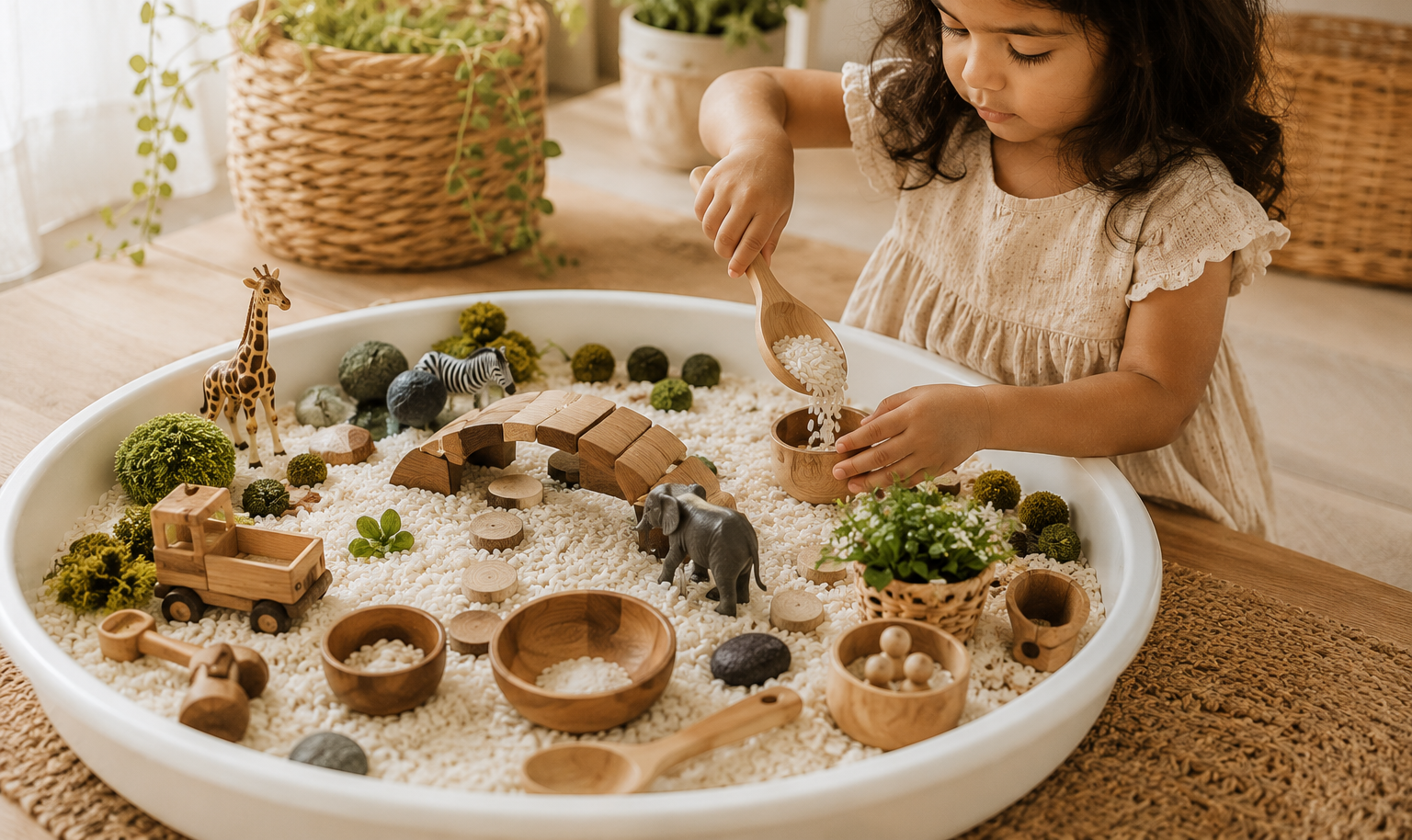
A tray your child loves is one they can use without constant help. The setup should match their current skills, not what looks good in a photo.
For babies who can sit, focus on safe textures and simple touch. A little water in a shallow tray, large fabric squares, or edible atta dough can work well with close supervision.
For toddlers, choose big tools and clear actions. Spooning rice from one bowl to another may look basic, but it builds hand control and focus. Toddlers repeat because repetition helps them learn.
For preschoolers, add pretend play and sorting. They may enjoy “feeding animals,” matching colours, making patterns, rescuing toys from foam, or washing vehicles.
For older children, add a problem to solve. Can they build a bridge? Create a rangoli pattern? Sort objects by size? Make a mini habitat for a toy animal?
A useful sensory play tray grows with the child. The same rice tray can become a pouring tray, a treasure hunt, a counting game, a pretend shop, or a small world scene.
Keep safety simple and non-negotiable.
Sensory play should feel relaxed, but safety comes first.
Keep these checks in mind:
Supervise closely, especially with children under three.
Avoid small hard items if your child mouths objects.
Check for allergies before using food, flowers, soap, or scented items.
Skip sharp tools, glass, and anything that can splinter.
Use clean materials, especially for babies and toddlers.
Keep water play shallow and supervised at all times.
Watch for slippery floors after wet play.
Avoid strong fragrances and glitter, as they can irritate skin and eyes.
Food play can feel wasteful if you use large amounts. Use small quantities, rotate dry bases, and store clean, dry materials in labelled containers for reuse.
For children with sensitive skin, start with plain, unscented materials. Rice, water, soft cloth, and simple dough are often better than brightly coloured or scented options.
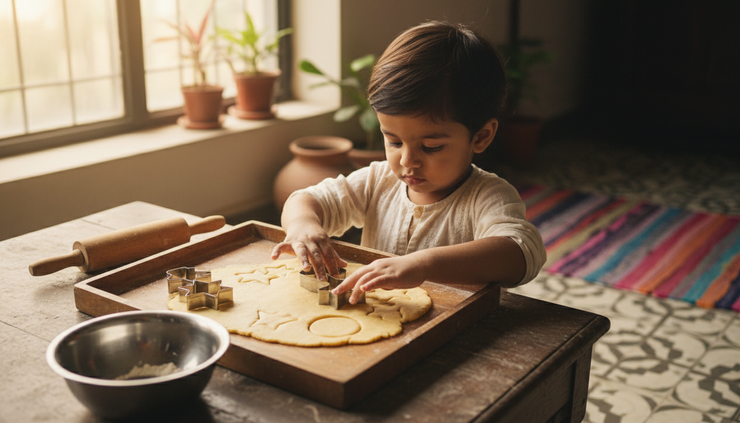
Set up the tray in five calm steps.
Once you have the basic materials, follow this simple process.
1. Pick the play goal
Choose one main kind of play for the day.
It may be:
Scooping and pouring
Sorting colours
Pretend cooking
Washing toys
Finding hidden objects
Making patterns
Building a small world
This keeps the tray focused. If the goal is pouring, you do not need ten animal figures and three colours of foam.
2. Add the base
Pour a small amount of the base into the tray. You can always add more later. For dry bases like rice or dal, start with one or two cups. For water play, use just enough to scoop, wash, or float toys. Less material often means more control and less clean-up.
3. Place two or three tools
Add tools that match the action. For pouring, use bowls and spoons. For sorting, use tongs and an ice cube tray. For washing, use a sponge and a small towel. Keep the tools visible. Children are more likely to start independently when they can see what to do.
4. Add one surprise
A small surprise can make the tray feel special.
Try hiding:
Toy animals
Large buttons for older children
Laminated picture cards
Shells
Felt shapes
Puzzle pieces
Wooden blocks
Make sure every hidden object is safe for your child’s age.
5. Step back and observe
Do not rush to explain every part of the tray. Sit nearby and watch what your child does first.
They may ignore your intended idea and invent their own. That is still meaningful play. If they seem stuck, model one simple action. Scoop once, pour once, then hand the spoon over. A good line to use is, “I wonder what happens if we pour this here.” It invites thinking without taking over.
Use language without turning play into a lesson.
Sensory play supports language best when adults describe what is happening in a natural way.
Instead of asking many questions, try gentle observations:
“The rice is falling fast.”
“That bowl is full now.”
“You found the red car.”
“The dough feels soft.”
“You made a long road.”
Questions have a place, but too many can interrupt focus. If a child is deeply engaged, quiet presence is enough.
When you do ask, keep it open:
“What should we cook next?”
“Where is the tiger hiding?”
“How can we move the water to this bowl?”
“Which one feels rough?”
This keeps play playful while building vocabulary and thinking skills.
Try three ready-to-make tray ideas.
If you are not sure where to start, use one of these simple setups.
Tray idea | What to add | Why children enjoy it |
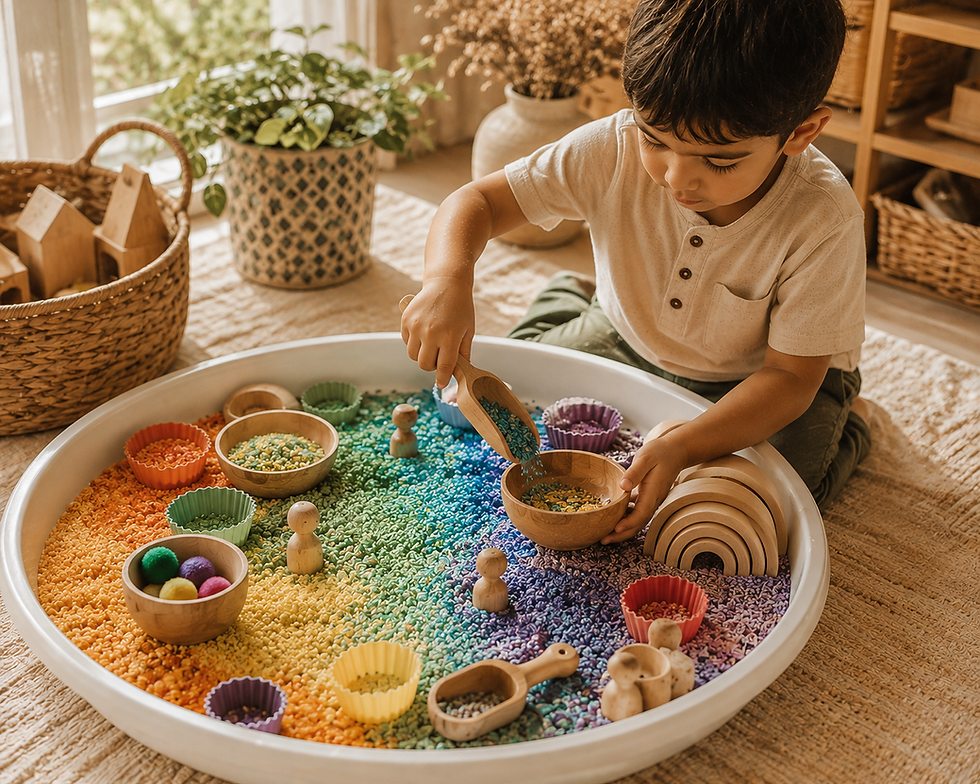
Rainbow rice tray | Coloured rice, spoons, bowls, pom-poms | Bright colours and scooping make it easy to start |
Animal rescue tray | Toy animals, oats or rice, tongs, small bowl | Children love finding and saving hidden toys |
Car wash tray | Toy vehicles, water, sponge, towel, small brush | It combines water play with pretend cleaning |
For coloured rice, mix rice with a tiny amount of food colour and let it dry fully before play. If you prefer not to colour food, use plain rice with coloured bowls, paper shapes, or toys.
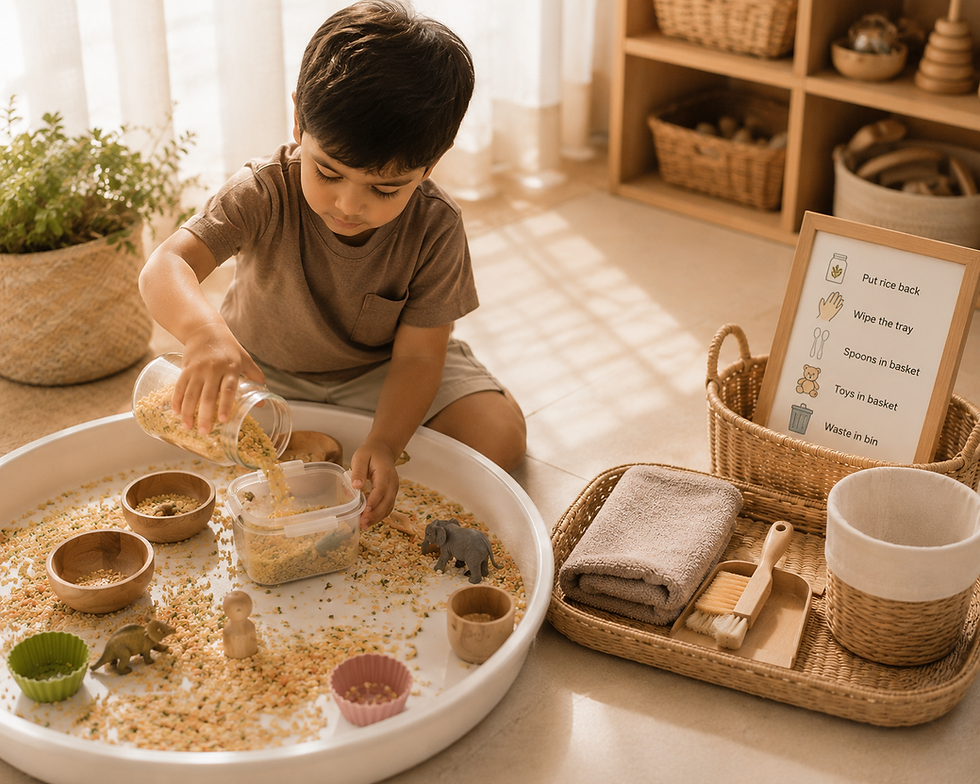
Make cleanup part of the routine.
Cleanup feels easier when it starts before the play begins.
Set out:
A tray or mat under the play area
A small dustpan for dry play
A towel for wet play
A container for reusable materials
A bin nearby for waste
Give your child a small role. They can pour rice back into a jar, wipe the tray, collect spoons, or place toys in a basket. Keep the language calm and clear: “The rice goes back in the box.” “The wet toys go on the towel.” This turns cleanup into another practical skill, rather than a sudden end to fun.
If your child finds transitions hard, give a warning. “Two more scoops, then we will pack away.” Some children also respond well to a cleanup song or a visual timer.
Keep it fresh without making it complicated.
Children do not need a new tray every day. Small changes keep play interesting.
Change one thing at a time:
Swap spoons for tongs.
Add toy animals to a rice tray.
Turn water play into a washing station.
Add leaves and pebbles to make a garden.
Hide puzzle pieces in oats.
Use muffin cups for sorting.
Add a cardboard tunnel for toy cars.
Repetition is not boring for children in the way it can be for adults. A child may ask for the same rice tray for a week because they are practising control, testing ideas, and enjoying mastery. Store favourite dry materials in separate containers. Keep a small “sensory play kit” with spoons, bowls, tongs, droppers, and towels. When everything is in one place, setting up takes minutes.
Notice what your child loves most
The best tray is not the prettiest one. It is the one your child returns to, explores, and changes in their own way.
Watch for clues:
Do they love pouring?
Do they prefer soft textures?
Do they avoid sticky materials?
Do they enjoy pretend cooking?
Do they like hiding and finding?
Do they seek water play again and again?
Do they focus longer with fewer items?
These clues help you plan the next tray. A child who dislikes foam may love dry rice. A child who throws beans may need a bigger outdoor setup or larger tools. A child who mixes everything may be telling you that process matters more than sorting. Sensory play works best when it respects the child’s preferences while gently offering new experiences.
A tray they love is simple, safe, and open-ended
To create a sensory play tray your child will love, start small. Choose one base, add a few useful tools, include one playful theme, and stay nearby. Let your child lead more than you instruct.
The goal is not a perfect setup. The goal is a tray that invites curious hands, steady attention, and joyful repetition. When the play feels easy to set up and easy to clean, it becomes something you can return to often, not a special project saved for rare days.

Comments