Why Invitations to Play Are So Powerful: The Benefits for Creativity, Learning, Confidence and Child Development
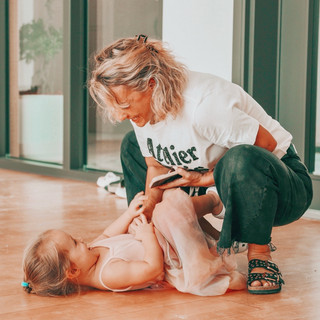
A child does not need a room full of expensive toys to become deeply absorbed in play. Sometimes, a tray of shells, a few stones, fabric scraps, cardboard rolls, blocks, leaves, bowls, and space to wonder can do far more.
That is the quiet power of an invitation to play. It does not tell a child what to make. It does not demand a correct answer. It simply offers materials, space, and possibility. From there, the child leads.
For parents, early years educators, and caregivers, invitations to play can look simple on the surface. Yet they support some of the most important parts of child development: creativity, problem-solving, language, confidence, social skills, fine motor growth, and emotional expression.
What an invitation to play really means
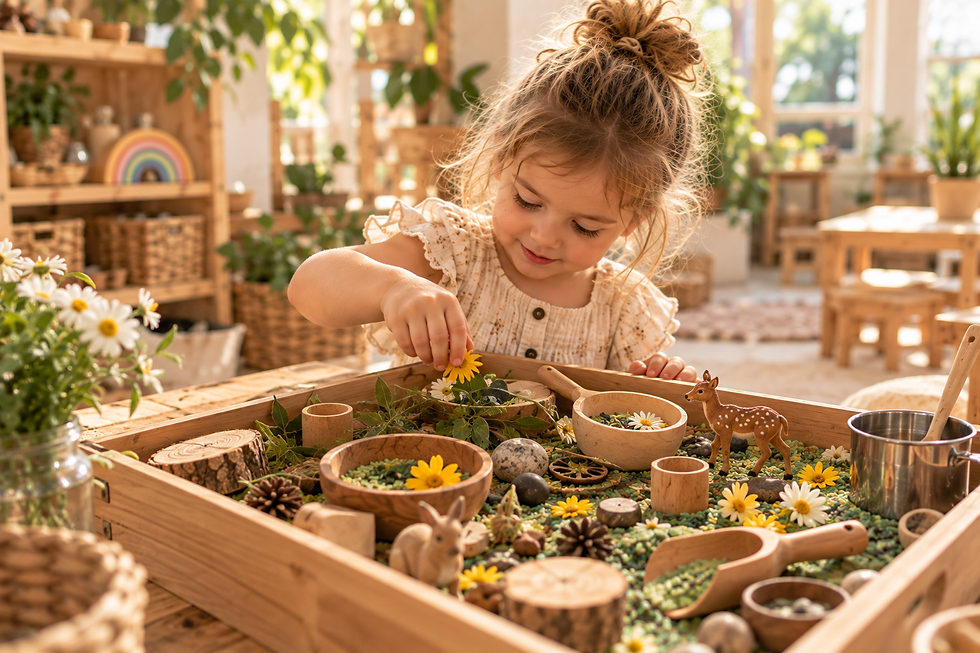
An invitation to play is a thoughtfully arranged play setup that encourages children to explore in their own way. It may include loose parts, art materials, natural objects, pretend play props, books, sensory items, or building materials. The key word is invitation. The adult sets the scene, but the child decides what happens next.
A tray with clay, twigs, bottle caps, and seeds might become a forest, a restaurant, a birthday cake, or a collection of treasure. A basket of scarves might turn into rivers, capes, tents, baby blankets, or bandages for soft toys. There is no single outcome. That is what makes it so rich.
This differs from an adult-led activity where children follow steps to produce the same result. Both kinds of activities have value, but invitations to play give children more room to direct their own thinking.

A good invitation usually has three qualities:
Open-ended materials The objects can be used in many ways.
A clear but flexible setup The arrangement looks appealing, but does not prescribe a final product.
Time and space Children can return, revise, repeat, and extend their ideas.
The setup does not need to be fancy. A corner of the floor, a dining table, a balcony, or a shaded outdoor space can work well. In many Indian homes, everyday items such as steel cups, dupattas, spice boxes, rangoli powder, coconut shells, bangles, pebbles, and cardboard cartons can become powerful play materials when used safely.
Invitations to play give creativity room to grow
Creativity is often treated as something that belongs only to drawing, music, dance, or craft. In childhood, creativity is broader. It is the ability to imagine possibilities, combine ideas, test them, and make something meaningful. Invitations to play strengthen this because they do not hand children a script.
When a child sees blocks, leaves, clay, and tiny animals, the adult may see random items. The child may see a jungle rescue centre, a temple courtyard, a train station, or a dinosaur planet. That freedom matters.
Closed toys often have one main use. A puzzle has a correct final picture. A battery-operated toy may perform the exciting part for the child. By contrast, open-ended materials ask the child to bring the play to life.
A cardboard box can become:
A bus
A shop
A cave
A robot costume
A doll house
A rocket
A quiet reading space
Each transformation requires imagination. The child must picture what is missing, fill those gaps, and assign meaning to ordinary objects.
This is why an invitation to play can be more powerful than a finished toy. It leaves room for the child’s mind to work.
Creative play also builds flexible thinking. If the tower falls, the child tries a wider base. If the cloth will not stay over the chairs, the child finds clips. If there are not enough “plates” for the pretend restaurant, leaves become plates.
That kind of thinking supports art, storytelling, science, maths, and everyday problem-solving.
Play builds early learning without turning it into a lesson
Children learn best when they are active, curious, and emotionally engaged. Invitations to play support this kind of learning because they make abstract ideas feel real.
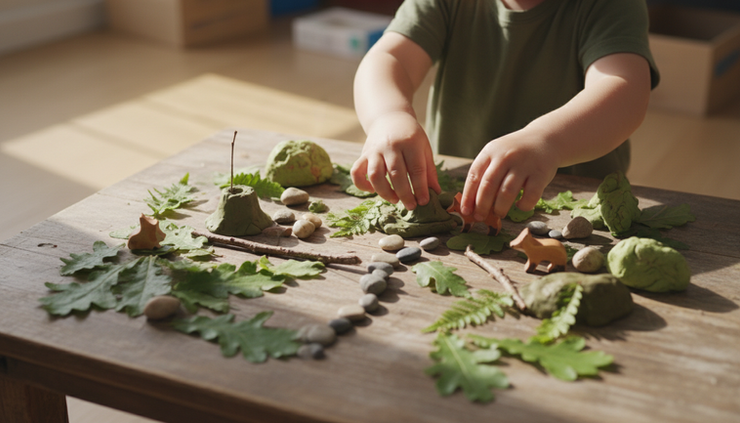
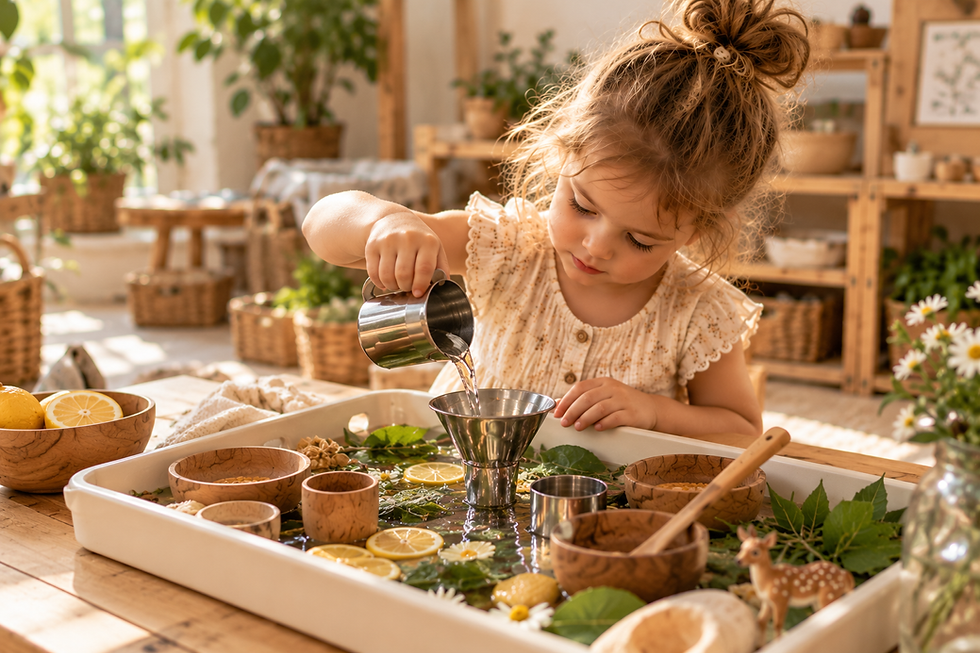
A child pouring water between cups explores volume, weight, force, and flow. A child sorting shells by size or colour practises classification, comparison, and early maths. A child making marks in flour or sand builds the hand movements needed for writing. A child building a bridge between blocks begins to understand balance, height, and stability.
None of this needs a worksheet.
Learning through play can include:
Area of learning | How invitations to play support it |
Language | Children name objects, explain ideas, negotiate roles, and tell stories. |
Maths | They sort, count, match, compare, measure, and notice patterns. |
Science | They test what floats, sinks, rolls, breaks, grows, melts, or changes. |
Fine motor skills | They pinch, pour, thread, stack, squeeze, cut, roll, and arrange. |
Social skills | They take turns, share materials, solve conflicts, and listen to others. |
Emotional growth | They act out feelings, practise control, and process experiences safely. |
The learning is not random. It comes through meaningful action.
For example, a child invited to play with dough, seeds, small bowls, and toy spoons may begin by making pretend laddoos. Soon, they may count them, divide them among soft toys, compare sizes, create a shop, ask for money, write a menu, or invent a family celebration.
One setup can move across several areas of development because children naturally connect ideas.
Adults can support this learning with gentle language:
“You made that one taller.”
“What do you think will happen if you add more water?”
“I noticed you sorted all the red pieces together.”
“How did you make it stand?”
These comments draw attention to thinking without taking over. The aim is to notice, not quiz.
Confidence grows when children lead the play
Confidence in children does not come only from praise. It grows when they experience themselves as capable.
Invitations to play give children repeated chances to make choices, test ideas, handle small frustrations, and see their efforts matter. A child chooses the material, changes the plan, solves the problem, and decides when the play feels complete. That sense of ownership is powerful.
When adults control every step, children may learn to wait for approval. When children lead, they practise trusting their own ideas. They also learn that mistakes do not end the activity.
A clay house may collapse. Paint colours may mix into brown. A block road may not reach the pretend market. These moments can cause frustration, but they are also rich opportunities. The child can repair, rebuild, adapt, or begin again. This builds resilience, which is a key part of confidence.
Praise can help, but specific noticing works better than general approval. Instead of saying only “Good job,” try responses such as:
“You kept trying until the bridge stayed up.”
“You found another way to attach the paper.”
“You chose different shapes for the roof.”
“You asked for help after trying it yourself.”
These comments show children what they did. They connect confidence to effort, thinking, and persistence.
Invitations to play also support quieter children. A child who may not speak much in a group might show complex thinking through building, arranging, pretending, or drawing. Play gives many ways to communicate.
Child development becomes visible through play
Play is not separate from child development. It is one of the main ways development shows itself.
When children play, they reveal how they think, what they understand, how they feel, and what skills are emerging. Adults who observe carefully can learn a great deal without formal testing.
A toddler repeatedly filling and emptying containers is exploring cause and effect. A preschooler lining up toy vehicles may be working with order, pattern, and control. A child pretending to be a doctor may be processing a recent clinic visit. A group building a shared city is practising planning, language, negotiation, and cooperation.
Invitations to play make this visible because they slow things down. The materials are open enough for children to show their own ideas.
Different kinds of development often appear together.
Physical development
Small muscles grow stronger when children pinch beads, squeeze dough, twist lids, stack blocks, scoop grains, or draw lines. Large muscles develop when they build dens, carry cushions, move cartons, balance on safe logs, or create obstacle paths.
Cognitive development
Children compare, predict, classify, count, sequence, and solve problems. They learn that actions have effects. They also learn to plan and revise.
Language development
Play gives children real reasons to use words. They create names, describe actions, explain rules, ask questions, and negotiate roles. Story-rich invitations are especially useful for vocabulary and sentence building.
Social and emotional development
Children practise waiting, sharing, leading, following, agreeing, disagreeing, and recovering from disappointment. Pretend play lets them explore fear, care, anger, joy, and comfort in a safe way.

The adult role is to prepare, observe, and gently extend
An invitation to play does not mean adults disappear. It means adults shift from director to thoughtful guide. The adult role has three parts.
Prepare the space
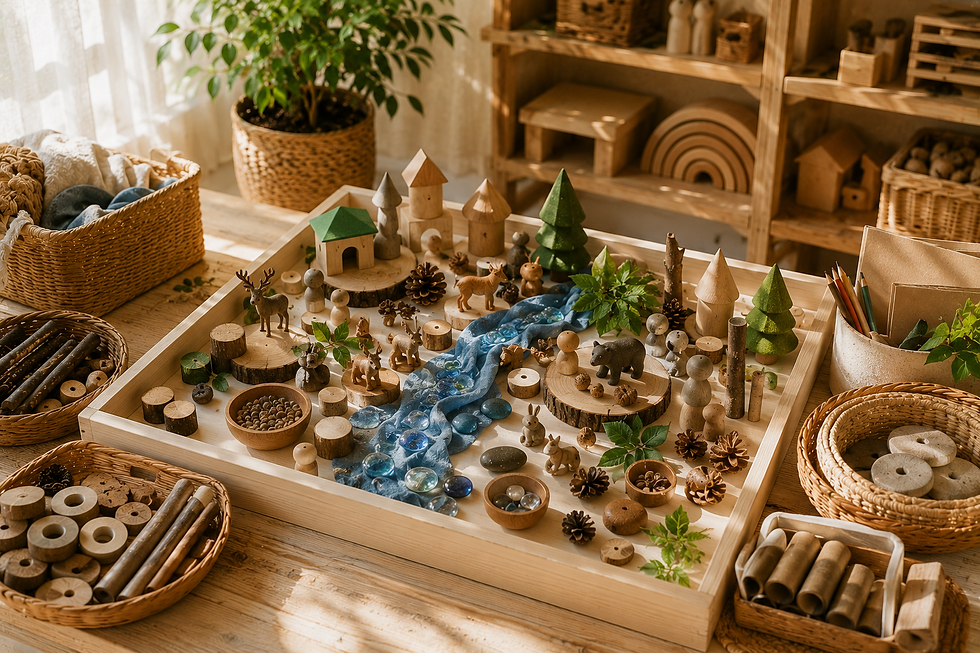
Choose safe, age-appropriate materials and arrange them in a way that feels welcoming. Too many items can overwhelm children. A small, clear selection often works better.
For younger children, avoid small choking hazards. For mixed-age spaces, place tiny items where only older children can access them under supervision.
A simple invitation might include:
A basket of fabric pieces and soft toys
Blocks with animal figures and blue cloth for water
Dough with rolling pins, leaves, and seed pods
Paper, crayons, tape, and cardboard scraps
Steel bowls, spoons, dried pasta, and cups for pretend cooking
Natural and household materials are useful because they are familiar. Children often play deeply with objects they recognise from daily life.
Observe before stepping in
Adults often step in too soon. A child struggling with balance, sorting, or sharing may be in the middle of learning something important.
Pause and watch. Ask:
What is the child trying to do?
What strategy are they using?
Are they frustrated or still engaged?
Do they need help, or do they need time?
This pause respects the child’s thinking.
Extend gently
When the play starts to fade or the child seems ready, offer a small extension. The key is to avoid taking over. You might add a new material, ask an open question, or describe what you see.
Helpful questions include:
“What else could this become?”
“Who lives here?”
“How can we make it stronger?”
“What do you need next?”
“How will the animals cross the river?”
If the child ignores the suggestion, that is fine. Their idea may be better for their play than the adult’s idea.
Simple invitations to play that work at home or in school
The best invitations are not always the most beautiful. They are the ones children can enter easily and change freely.
Here are practical setups that need little preparation.
A loose parts sorting tray
Use shells, buttons, stones, bottle caps, seed pods, large beads, or fabric circles. Add small bowls or an egg tray. Children may sort by colour, size, shape, texture, or their own categories. This supports maths, fine motor skills, and decision-making.
A pretend kitchen corner
Use safe kitchen items such as steel bowls, spoons, cups, cloth pieces, and empty containers. Add dough, leaves, or large dry pasta if suitable. Pretend cooking builds language, sequencing, social play, and cultural connection. Children often recreate family routines, festivals, markets, and meals.
A storytelling basket
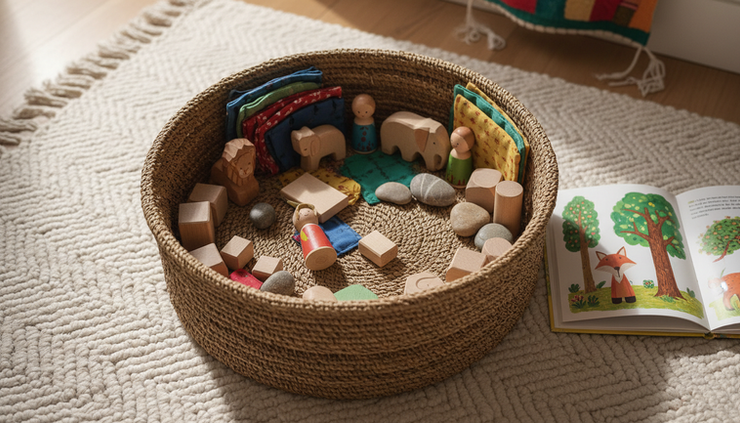
Place a few animal figures, people figures, small cloths, blocks, and natural items in a basket. Add one picture book nearby. Children can retell familiar stories or invent new ones. This supports imagination, vocabulary, memory, and emotional expression.
A mark-making station
Offer paper, crayons, chalk, water and brushes, sand trays, or slate boards. Add envelopes, old calendars, or simple handmade cards. This builds early writing skills without pressure. Scribbles, lines, dots, and pretend letters all matter.
A building challenge without instructions
Set out blocks, cardboard tubes, tape, cloth, and small vehicles. Let children decide whether to build roads, towers, homes, bridges, or ramps.
This supports planning, spatial awareness, persistence, and early engineering thinking.
Common mistakes that make invitations less effective
Invitations to play work best when adults keep them simple and child-led. A few habits can reduce their value.
One common mistake is making the setup too perfect. If it looks like it must stay beautiful, children may hesitate to touch it. Play should be allowed to become messy, rearranged, and surprising.
Another mistake is expecting a specific result. If an adult sets out leaves and paper expecting a collage, the child may instead make tickets, soup, or a bed for a toy cow. That is not failure. That is the invitation working.
A third mistake is asking too many questions. Questions can support thinking, but constant questioning can feel like a test. Quiet observation is often more useful.
Screens and ready-made entertainment can also reduce deep play time when they fill every gap. Children need unhurried moments where nothing performs for them. Boredom can be uncomfortable at first, but it often leads to invention.
The final mistake is assuming older children do not need this kind of play. They do. The materials may change, but the need for open-ended exploration remains. Older children may build more complex structures, create comics, design games, make miniature worlds, or use recycled materials for inventions.
The lasting value of being invited to play
Invitations to play are powerful because they respect children as thinkers. They offer just enough structure to begin, and enough freedom for children to make the play their own.
Through these simple setups, children imagine, test, speak, build, sort, negotiate, repair, and try again. They learn that their ideas matter. They learn that problems can be solved. They learn that there are many ways to use the same material, tell the same story, or reach the same goal.
The adult does not need to create something elaborate every day. A small basket, a tray, a few household objects, and a calm stretch of time can be enough.
The real gift is not the setup itself. It is the message behind it: here are some possibilities, and your ideas are welcome.

Comments